

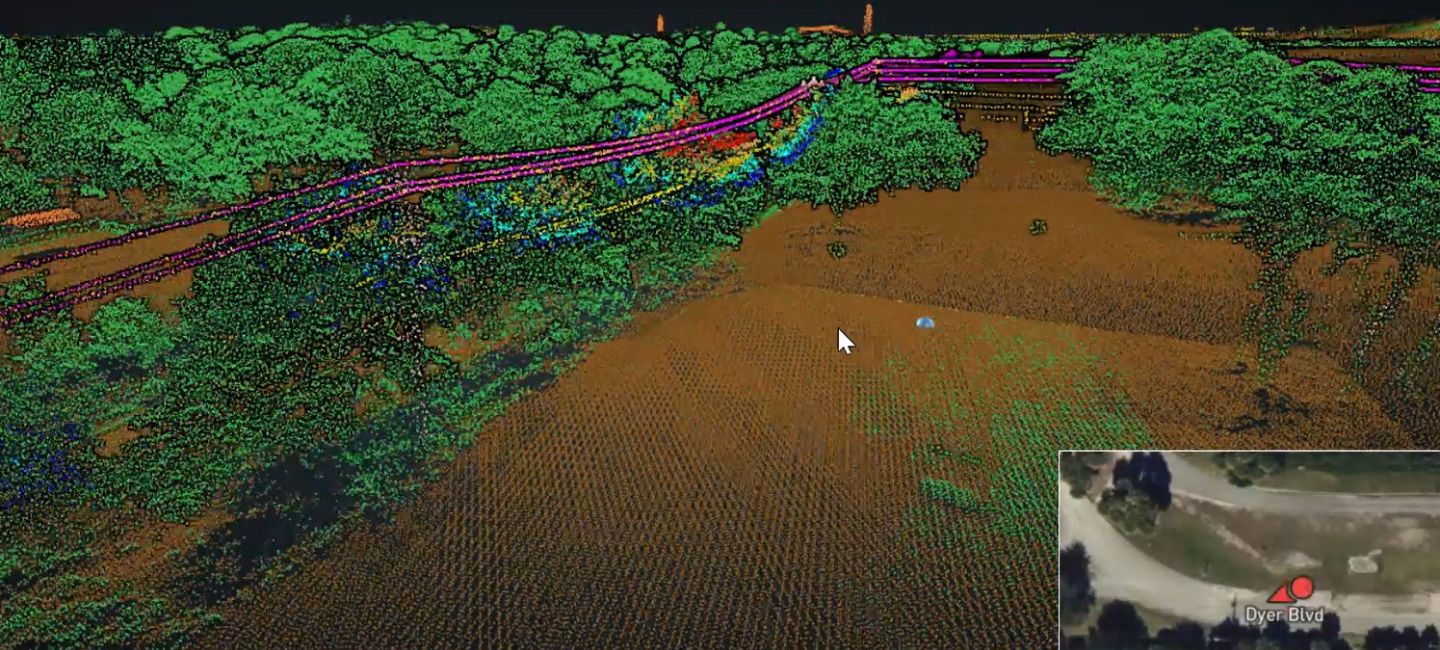
WEST PALM BEACH, Fla. — In Florida’s fast-growing landscape, trees are one of the leading causes of power outages. To stay ahead of that challenge, Florida Power & Light Company is blending advanced light detection and ranging (LiDAR) technology, decades of hands-on experience and the next generation of problem solvers to build a smarter, more predictive approach to vegetation management.
Across Florida, FPL’s vegetation management team is using LiDAR data to better determine where trees are growing near power lines and where trimming is needed most to help maintain the reliable flow of electricity. Through partnerships with universities across the Southeast, students are helping turn years of vegetation data into predictive models that could help deliver reliable service to customers during good weather and bad.
“This is about working smarter,” says Erin Schreck, vegetation operations lead for FPL’s east region. “We’re combining decades of field experience with advanced technology to make better, faster decisions that directly improve grid resilience.”
Vegetation trimming has traditionally followed set three- and six-year cycles. While this is currently the most effective approach, with improved technology, FPL can more accurately predict how quickly vegetation grows across Florida’s diverse landscapes.
“Fast growing species like palms or bamboo don’t always align neatly with a fixed trimming cycle,” Schreck says. “Some areas could benefit from attention sooner, while others may not pose the same level of risk.”
Each year, FPL conducts a statewide LiDAR collection that captures 50,000 miles of data on its power lines, creating a detailed three-dimensional view of vegetation and its proximity to overhead equipment. The data gives arborists an accurate, systemwide view of vegetation conditions without having to walk every mile of line.
“Work that once took months to patrol can now be planned in hours,” Schreck says. “That allows us to focus our field time where it matters most.”
While LiDAR shows where vegetation is today, FPL wants to understand where it will be in the future.
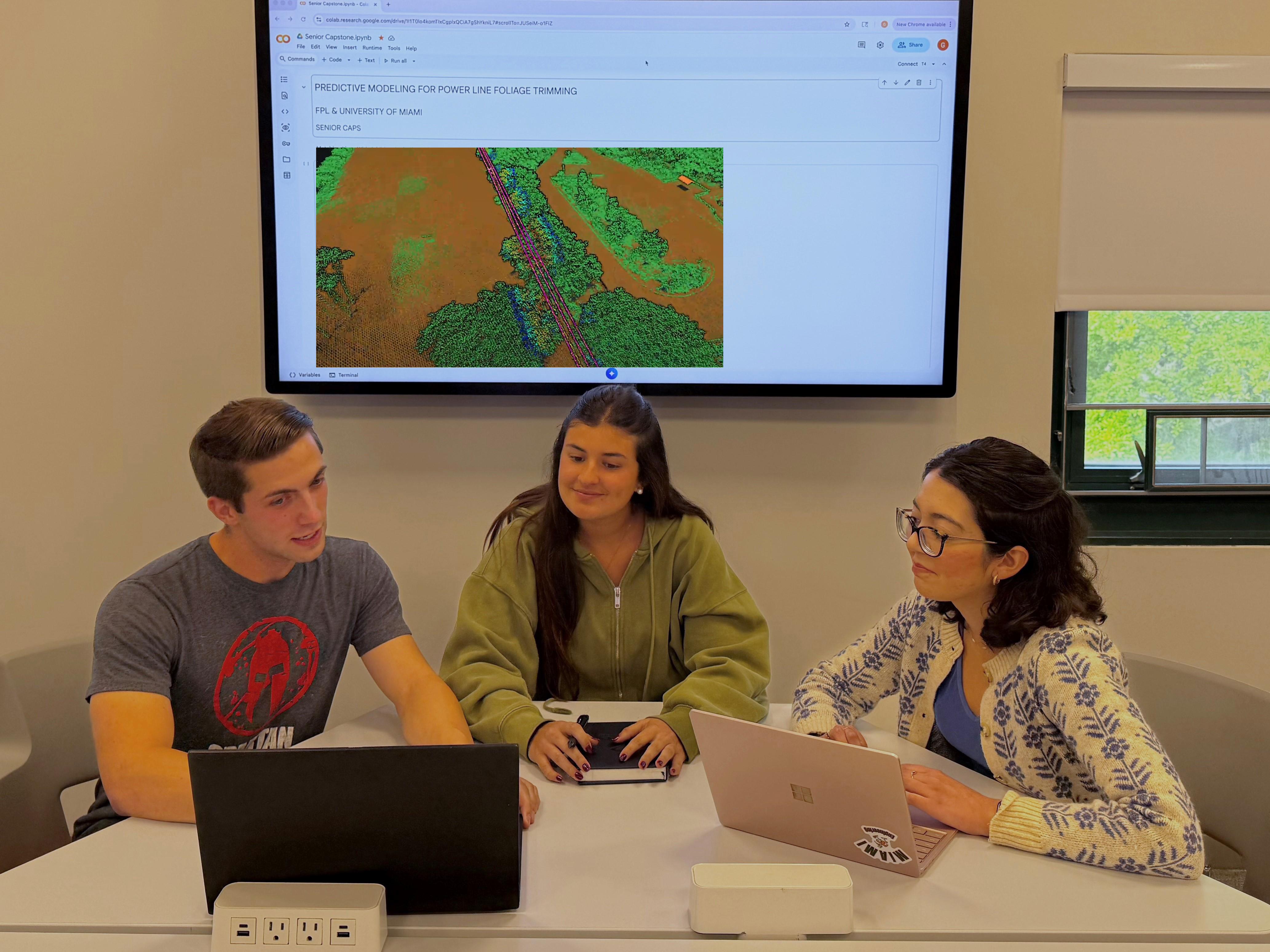
To help answer that question, FPL partnered with the University of Miami, the University of West Florida and Auburn University through senior capstone programs. Students majoring in engineering and computer science were given multiple years of LiDAR data and asked to build predictive growth models.
“These students are the analytical engine behind the work,” says Tiffani Rodriguez, lead project manager in operations services. “They’re working with real FPL data and tackling real operational challenges.”
For the vegetation management team, working with students has brought new insights and new ways of thinking.
“The questioning attitude students bring to their analysis has helped the vegetation management team reflect on our processes and priorities,” Schreck says. “One insight was clarifying what matters more operationally: grouping work by circuit or by growth rate.”
“Traditionally, we trim an entire circuit, but with the student growth model, we may be able to take a more sectionalized approach based on localized tree growth rates.”
Students are also studying how environmental factors – like rainfall – influence growth rates, helping the team better understand why some areas experience faster vegetation growth than others.
“If we can identify the drivers behind growth patterns, we can build stronger predictive models,” Schreck says. “That allows us to plan maintenance earlier and more strategically.”
The long-term goal is a shift from cycle-based trimming to a more predictive, risk-based approach—one that targets high-growth, high-risk areas earlier.
“By layering vegetation forecasts with customer reliability data, we can focus resources where they’ll have the greatest impact,” Schreck says. “That means fewer vegetation-related outages and more proactive maintenance.”
For customers, the benefits are straightforward: fewer service disruptions and a smarter approach to managing Florida’s fast-growing landscape.
Beyond the technology, Rodriguez sees the partnerships as an investment in people.
“These collaborations allow FPL to explore innovative ideas while also developing the next generation of talent,” she says. “Students gain hands-on experience working with real data on critical infrastructure, and FPL benefits from fresh perspectives and innovation.”
For students in the capstone project, the experience brought classroom concepts to life.
“While learning about modeling and data analysis in class is incredibly useful, being able to apply what we’ve learned to a hands-on, real-world project has taken that learning to another level,” said Gabriella Bueno, a Bachelor of Science in Industrial Engineering student at the University of Miami. “Working alongside a team like FPL’s, who are so knowledgeable, supportive and willing to guide us through every step, has made this project even more educational.”
For Rodriguez, helping connect students with meaningful work is especially rewarding.
“I get to help bridge the gap between academia and operations,” she says. “Knowing these students are contributing to solutions that improve reliability for millions of customers—that’s something I’m proud of.”
As Florida continues to grow, so does the landscape around FPL’s infrastructure. By blending field expertise, advanced data and academic collaboration, FPL is reshaping vegetation management and building a stronger, smarter and more storm-resilient system from the ground up for the millions of customers who depend on it every day.
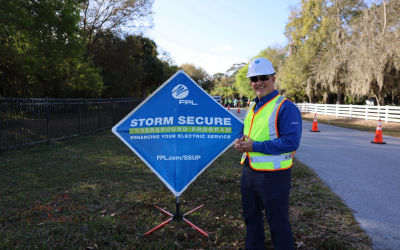
John Giraldo has spent his career strengthening South Florida’s grid through FPL’s Storm Secure Underground Program—building a more resilient future for the community he calls home.

At FPL’s Reliability Assurance Center, engineer Wigberto “Wiggy” Flores-Hernandez tests equipment to withstand Florida’s lightning and keep crews and customers safe.